
These are the notes which I loosely used in my paper at the recent BIAPT Conference. I am submitting a short piece arising out of it to Practical Theology
Croeso i Gweithdy. Welcome to the Workshop
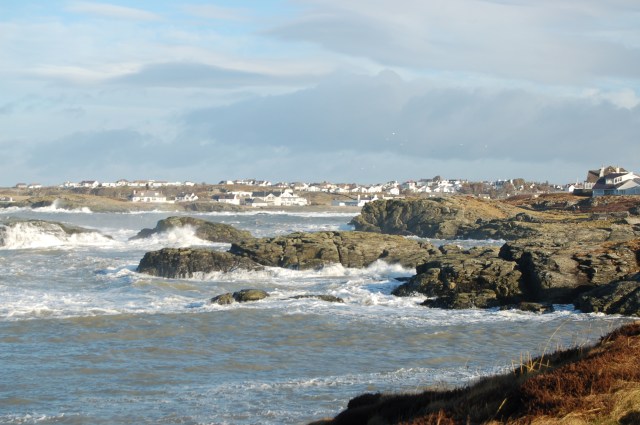
Mae hyn yn fy stori. Dw i’n symud i Bae Treaddur o Birmingham yn mis Chwefror 2014.
This workshop reflects on my move from England to Wales. It is therefore personal – all theological engagement is.
It is an engagement with a continuing journey. Ostensibly, it is about moving from one part of the British Isles to another (I always accepted Britain was bigger than England; coming from the North helps perhaps), but also from one nation to another (I probably did not understand the concept of Wales as a separate nation).
Much more than that it is a narrative that is beginning to unravel what it might be to be Welsh (this by a man who had rarely set foot in Wales, and been to Holyhead once before en route to Ireland) and within that what it might mean to be English (would I use that term to describe myself, I have always defined myself by my regional Yorkshire identity)
It is about doing theology and discovering that what I had presumed had been a shared history is far from that; and perhaps it is not too presumptuous to assume that the much heralded characteristic of English fair play does not appear to have been in evidence with how the English or British establishment had dealt with the people of Wales. It is a theology that begins to feel what it might be like to be the oppressor in the narrative. For someone who tends towards being inclusive in many of the current ecclesiastical and societal debates, it has been at times galling to reflect on the not always positive impact of England upon Wales. There are four contours that have become important in my journey: language, history, Landaff rather than Canterbury, and devolution.
When you are new to a context, you meet lots of people, and also go out of your way to introduce yourself. On one such occasion, I sat with the Head of the local secondary school for the first time. About 20 minutes in, I was struck deeply and profoundly by his words.
‘My Dad was caned at school for speaking Welsh and made to wear the knot. Whenever I meet someone who is from England, I remember that and our history’
I had no idea of that the Westminster government had tried to make English the first language of Wales. I knew nothing about pupils being punished for simply speaking their mother tongue. I knew nothing of what the Headteacher termed ‘our history’
I knew nothing of the so-called Blue Book or Brad y Llyfrau Gleision which the 1847 Government report into State of Education in Wales has become known.
Two quotes illustrate its conclusions
Teach English and bigotry will be banished
The Welsh language is a vast drawback to the Welsh and a manifold barrier to the moral progress and commercial prosperity of the people. It is not easy to overestimate its evil effect`
Some of the attempts to make English normative were dressed as enabling different choices to be made. In order to improve pupils’ knowledge of the English language, the Welsh education system of the late 19th century employed the ‘Welsh Not’ or ‘Welsh stick’ as a method of discouraging children from speaking Welsh. This small piece of wood was given in turn to individuals overheard talking Welsh, and whoever was wearing it by the end of the week was often severely punished.
Whilst such practices officially fell away in the early 20th Century, in parts of Anglesey they continued. Several of my congregation from their late 40s to late 70s recall wistfully Welsh being sidelined in order to enable them to get on.
Coupled with the official and unofficial repression of the language, there has been a continual suspicion and perhaps mockery from across the border.
If an Englishman enters a shop in Welsh-speaking parts of Wales, the locals are likely to switch promptly to speaking Welsh. Thus the Englishman cannot be sure whether they are talking about him
This comment was made in 1994 by the then Secretary of State for Wales, John Redwood. In addition, one might reflect on game shows and comedy routines that seem to poke fun at Cymraeg that are acceptable, when perhaps if it was directed at another language, it might be construed as racist.
Ond, Dw i’n dysgu Cymraeg achos i ddangos parch at ddiwylliant Cymru.
Another conversation between a Welsh colleague and me was equally poignant
‘We are a conquered people. Your Castles are still here. We remember, even if you do not’
My immediate response was not did I remember, but how little I knew. Did I know anything about the wars between England and Wales? I knew nothing of the viciousness of Edward I.
Indeed I can recall being given by first tour of Ynys Mon, and the village that is called Niwbwrch or Newborough. The “new borough” was created when the English king, Edward I, removed local people from Llanfaes in the South East of Anglesey so his builders could get on with the construction of Beaumaris Castle which guards the eastern end of the Menai Strait (Afon Menai) and at the time served to control Gwynedd.
I had no idea of the imposition of English law on Wales. The Act of Union between England and Wales set aside a legal code more ancient that that of Westminster. The Union between the two nations was one between conquered and conqueror in a way that the Union between England and another Celtic nation, Scotland, was not. It is perhaps the keeping of a distinct legal code as well as it different education system that makes Scotland more confident that the stateless nation of Wales.
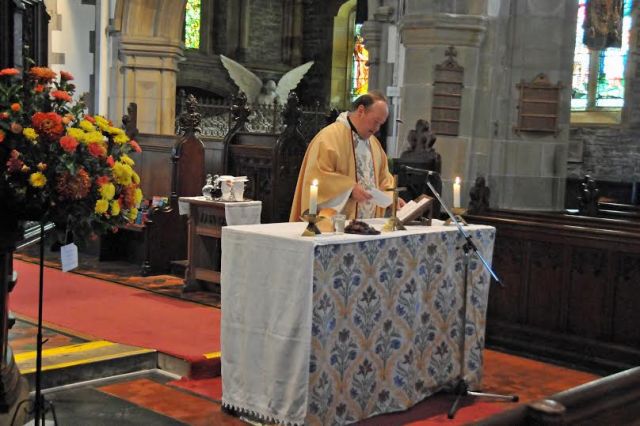
Another strand to this narrative is the move from one Anglican Province to another, from the Church of England to the Eglwys Yng Nghymru. Like the majority of Anglican provinces, the Church in Wales is not established. Moreover, it is a popular maxim that church of the Werin Gymreig (Welsh Folk) was very much a nonconformist church, forged by a history of being Christian dissenters. This is only partially true. No doubt the Church of England in Wales did at times represent an English Chaplaincy abroad, and its Oxbridge educated bishops and clergy appeared to be aloof from the working communities of Wales; and, yet the suggestion that the working folk chose the Capel rather than the Eglwys as their spiritual home needs to be carefully and patiently re-evaluated. Notwithstanding this, it does appear to be true that the Chapel was Welsh speaking and by and large Church, English.
The Disestablishment and disendowment of the Welsh Church through the Welsh Churches Act in 1914, coming into effect in 1920 was the result of a very lengthy campaign by nonconformist church leaders and politicians alike, with Gladstone reputed to have declared that his aim was to rid Wales of the foreign Church. Neither Church nor Chapel leaders covered themselves in glory during the campaign that led to disestablishment. Church leaders seeming to want to make a connection between themselves and the ancient Celtic Church, and at the same time noncomformists seemingly wishing to disembowel as well as disestablish and disendow the Church of England in Wales. Much energy on both sides was put into this debate, when just a decade after 1904 Christianity in Wales was beginning to decline.
There is one other contour that is important for setting the context in which theology is done. In 1999, a measure of devolution came to the Wales by the slimmest of margins. In the referendum held on that day Wales voted by Yes 50.3% / No 49.7%) in favour of a degree of self government, realised in the Welsh National Assembly. There does appear to be a measure of increasing self-confidence in the nation. Whether the bitter cuts of austerity which are destined to hit Wales will strangle this fragile confidence remains to be seen. Wales is defining itself.
Where Wales might once have found its identity in Christian belief, this is no longer the case. Wales like the other nations of the British Isles is increasingly secular, and the stories of Celtic saints that shaped the nation or of the 18th and 19th Century non-conformity, and even of the Roberts revival hold comparatively little sway. Non-conformist divines may have seen similarities between Israel and Wales in terms, yet such concepts would be alien to most families living and working within Wales.
Politicians of all hues cite inclusiveness as one of the features of the modern Wales. This begs the question how can you hold together those who are first language Welsh, English incomers, and Welsh people who will only use English to the name but a few groups.
Wales has much in common with its Celtic sibling, Scotland, and yet politically there are significant differences. Plaid Cymru is not yet the Party of Wales in the broadest sense. Labour or Llafur still holds a dominant sway, and the rise of UKIP cannot solely be put down to the English incomers. In my town of Holyhead, where poverty is as deep and marked as some parts of Liverpool and Manchester, voters tune in all too easily to its message.
How then does one do theology within these contours: lines on a constantly changing map? Indeed part of doing theology within the Church in Wales, is simply introducing regular worshippers to the changes that have taken place.
One of the first steps to take when doing theology in Wales is to note not only the bi-lingual nature of the nation, but also the cultural context is so very different to that of its next door neighbour’s.
I have to accept that my Englishness can be a barrier, not being English itself, but how the English State has effortlessly acted in a colonising manner to Wales, sometimes with benevolence, but often not.
Theology within such a context is, for me, tentative and always provisional. It helps that I am learning Welsh.
Bi-lingualism though within the context of capel and Eglwys is not primarily to do with which language is used, rather it is about understanding, and perhaps recalibrating the place of faith communities within Wales. The halcyon days of revival, renewal and centrality have disappeared, and Christian faith communities encompassed more than established church and conformists. Other faith groups flourish. Densil Morgan notes that ‘Evangelism divorced from radical and wholehearted social responsibility will fail, and deserve to fail’. Dare I add that evangelism for the purposes of recruitment and retention of either church or chapel should also deserve to fail? This though is a concern both within the Church in Wales and traditional nonconformist chapels; the depth of our decline means there is a temptation just to put the proverbial bottoms of not very comfortable seating arrangements.
The commitment to the common good should see local church congregations and faith groups at the forefront of finding answers to the question what does it mean to be Welsh in a 21st century context. An English incomer might raise his eyebrows at the notion that was seemingly widespread of Wales or the Welsh as a religious nation or holy remnant. If this was truly the case, it has gone now.
Wales and Welshness has been defined by its relationship with its neighbour. This English priest is committed to enabling in some small way Wales to step out of its neighbour’s shadow. True it sometimes does, particularly when playing sport against England. But this stepping out needs to become more routine. I would argue that a greater appreciation of the history of the two nations from both sides would help. The continued renewal of Welsh will underpin such self-confidence, but must be done in a way that does not exclude. I might suggest that this redefinition will need, perhaps even demand a greater degree of devolved government, and in time, independence as Wales shares its passions, history, culture and indeed faith in the family of nations.