Green shoots of hope

There is every reason for optimism. That seemed to be the essential message of Archbishop Justin’s sermon at the launch of his public ministry as Primate of All England. I have to say I concur with him.

It is not that as Anglicans we do not have to be concerned at declining numbers. Numbers, however, do not tell the whole story. Our electoral roll has officially diminished by 20. This is in a large part because of the overall renewal of Anglican electoral rolls this year. However, that diminished number does not reflect those who have joined and those who have joined a church for the first time.

I am therefore optimistic. I am optimistic about recapturing the imagination of local people with regard to the Christian faith. Recapturing the public imagination for faith was one of the goals and achievements of Rowan’s archiepiscopate.

I am particularly encouraged by ++ Justin’s declaration that we are to be rooted in Christ. If we are so rooted, optimism or realism will never be far away.

Posted in Uncategorized | Leave a comment

Frodo’s way: excelling

Those of you who have followed this a little will know doubt be aware of the trials and tribulations of Frodo, and how much he has taught me since he had his leg amputated back in December. He has adjusted and coped, and so have I. We walk round Bartley Green together with a sense of pride; the balding, slightly rotund vicar and his three legged lurcher. He has caused me to slow down. Frodo has shown me that being vulnerable is not something I preach about and even sometimes write about, but is a pattern for living. Here is a picture of him running today.

DSC_0173

He is doing what he does best; he is living. And I am trying to follow his example.

Posted in Uncategorized | Leave a comment

Sermon for Lent 3

In the Name of God, who is uniquely revealed as Father, Son and Holy Spirit

If we did not have the Gospels, historians would still be able to tell us that Pontius Pilate was a ruthless governor of Palestine.

From the First Century historian Josephus, we would know that Pilate was not averse to either using ruthless violence or causing offence; whether that be by the crucifixion of over 200 zealots on the Sabbath or placing Roman emblems, which were dedicated to the Roman Emperor in the Jewish temple. Pilate seems to know just how to make the collective blood pressure of those he was supposed to govern rise. One of the features of Luke’s two volume work is the positive position he takes about those in authority; our Evangelist never though allows the abuse of power to be tolerated.

Therefore, Luke tells us of another act of outrage: that of mixing of the blood of Galilean rebels with their sacrifice. All this would tell us that Pilate knew or cared little about the story of God as lived out through his chosen people, Israel.

A summary given in a few lines does not quite capture the fury that would have been felt by the procurator’s actions. Imagine a leader ordering the slaughter of worshippers in St Peter’s Square, at western wall in Jerusalem or in Mecca or of a king, commanding the murder of an archbishop in Canterbury Cathedral, and you will get close to the national and international anger that would have been felt.

Jesus does not comment about Pilate but instead asks those gathered around him whether or not they believed that those Galileans were worse sinners than others from Galilee. It was common to link disaster or illness with wrong doing in an almost mechanical sort of way. It is certainly my experience in ministry that we still operate in a similar way, even if we pretend to be a little more sophisticated.

If you find that difficult to believe, when have you not asked why someone suffers (usually a good person) and someone else does not? We still can find ourselves unhelpfully engaged in a philosophical debate that leads us down cul-de-sacs from which we never quite return.

Jesus does not enter such a debate; but instead after offering another contemporary example, rams home a message: unless you change your ways, you will meet the same end.

This is a hint perhaps at our mortality and the divine offer of life everlasting or perhaps a suggestion that the road Israel was on with its stubborn refusal to embrace the ways of God and/or pull back from its ridiculous attempts to rebel against Rome; those who live by the sword die by the sword; and buildings will crumble when an Imperial army surrounds you. Whichever explanation we accept, there is no escaping the hard edged nature of message given by Jesus: change or face the consequences. This is my first key point for today: the gospel message demands change.

At the very heart of the message of Jesus was the phrase ‘repent for the kingdom of God is at hand’. Too often we focus on the delights of the kingdom, and hide from the costs of repentance and the daily discipleship that follows. For both individual and nation it can be the refusal to accept that a changing the ways we live is necessary. Both have consequences and it is often easier to divert down blind alleys with questions about why individuals suffer or natural disasters occur than confront the reality that God demands that we live life differently.

Our Gospel reading continues with a story that has lost something in translation. In order to understand it, we need to know certain things: both the vineyard and the fig-tree were used as images for Israel. Jesus, those hearing him and reading the text would all know this. They would also know that the owner of the vineyard was usually taken to be God. When we acknowledge this; the story reads as follows. Israel had not borne fruit (presumably because she had insisted on going her own way). The owner of the vineyard is intent on wiping Israel out because of this. The owner is though persuaded to give Israel another chance. Those familiar with the biblical story will here echoes perhaps of Abram’s dialogue with God over Sodom and Gomorrah or Moses intercession on behalf of the people of Israel. It is an important part of the story that God demands much of those who choose to follow him. Those also familiar with the time of Jesus will be quick to point out that Jewish leaders described God as a ‘gardener’. What does it do to the story if God is the gardener: the one who pleads for the tree to be given more time? It makes God to be generous, merciful and reckless. It makes God different to ourselves. As humans, we often give up on people with relative ease. My second key point is then God offers us a different way of living and being.

Paul refreshes the memories or tells for the first time the story of Israel in the wilderness to the Church at Corinth; where God dealt fairly, graciously and robustly with his people. The Apostle recounts the story of how people who disobeyed or cut corners were dealt with. This was and is important not only as a history lesson. The poet, Steve Turner, is insightful in his brief poem entitled ‘History’.

History repeats itself. It has to. No one listens.

We all long to learn lessons from history. But many of us fail to do so. This is true on both a personal and community level.

Paul’s retelling was also essential, since we cannot live our lives properly as the people of God if we do not know the story. The story of God’s people, as revealed in the Scriptures sets the contours for our living today. This might on first hearing seem a little odd. Yet, we accept that families have stories which shape how they behave. The same is true of communities, and perhaps even nations. So do the people of God. Peppered through our story is a God of grace and love who calls a people; giving his people patterns for living, who demonstrate their own capacity for growing up and dispensing with the patterns only to end up in a mess; eventually returning to God who never gives up on them.

The Church calls us during Lent to learn again our story, which is why we are looking, at the overarching narrative of which Scripture told, in our Lent group. It is why we will shortly ask God in the Eucharistic prayer that we might grow in grace and learn to be people of God once again. One of the ways we will do this is ensuring that our biblical literacy is up to scratch. By doing so, we will be able to enter into the drama of the scriptures in a way we not be able to do so otherwise.

Those of you who were here last week might wonder where the outrageous grace of my hypothetical book on biblical interpretation has gone to. Commitment and Cost of discipleship are the flipside of grace and invitation. This is where our Old Testament reading might be helpful with the invitation that is offered by God in Isaiah to come to the waters and drink. God’s invitation is always to come as you are and to freely take part in the life offered for you. Accepting God’s invitation of a relationship does though involve change. Relationships change us for better or for worse. Just as in a marriage, husband and wife exchange and create a story; our relationship with God changes our story; as perhaps also does his story, which takes it into an altogether different and fascinating theological avenue.

Jesus in the Gospel of Luke was always inviting people to come to banquets as they were, eating with those who religious people said he should not. My third key point is that there is room for all at the table of Christ. However, there will be always those who refuse to come; either because the demands are too difficult or the message of inclusion and grace is deemed to be foolish. Before we start wondering what will happen to them; we would do well to remember that Jesus’ harshest words were to those of us who already thought we were sat at the table.

We prepare to declare in the God who judges as well as invites with a moment of silence.

Posted in Uncategorized | Leave a comment

Reflection Three: Busyness can be an idol

Making discoveries because of Time Wisdom as promoted by www.notbusy.co.uk is one thing; the application of these discoveries into my own life will be quite another. The suggestion that busyness can be a form of pride, which to my understanding is akin to making yourself an idol is sending shockwaves through the Ellis universe.

Posted in Uncategorized | Leave a comment

Reflection Two: already late

Already late? That is not a particular place to begin when attempting to reflect on being #notbusy. I had intended to offer a thought every day, so on day three; I am only on two. There is a reason; and perhaps a lesson learned.

Yesterday, I spent time at Birmingham Children’s Hospital as an anxious, concerned and worried parent. To all extents and purposes I was doing nothing. The absence of activity does not mean that nothing is being done. True other parents were utilising time communicating with the outside world through the power of modern technology. But I was not doing nothing. Indeed, had I thought about it, my laptop would have been with me.

I need to learn, imagine and wonder at the possibility that just clearing the diary does not mean that I am doing nothing. That’s enough of a discovery to cause me to go and do something else for a while. Being not busy is not a point in time but a habit that is formed.

Posted in Uncategorized | Leave a comment

Reflection One; 15 minutes

I have signed up for Lent with www.notbusy.co.uk which is the truly wonderful idea of giving up busyness for Lent. I have embraced it because I am so often a human doing rather than a human being.

The idea of being public about giving up busyness is to ensure we do it. One of the basic premises behind it is to set aside 15 minutes each day during the period of Lent to do nothing.

My first observation is that to nothing was very difficult. Admin became attractive, as did the possibility of finding the iron.

My second is that this could be a truly transformative experience, but I will have to do it more than once to be sure that the potential is there.

Hope Lent is blessed and holy for you all

Posted in Uncategorized | 2 Comments

space and story

I have had the privilege of being at two conferences this week. The first was Birmingham Diocese’s annual get together for priests and ministers serving on outer estates. The second was the growing churches day. This blog will mainly reflect on the first one.

It is firstly absolutely wonderful to spend time with colleagues working in similar, yet different, contexts. Secondly, there is a delight in being able to take time out. Thirdly, for me to facilitate a small group on engaging with those who are seeking was a gracious gift.

Out of that group came two words (themes, perhaps): space and story, which we thought were important when seeking to make connections with those interested in the Christian faith (and perhaps those who are not). I am fascinated by the idea of story, but space was something of a surprise. As someone comfortable with church space, I have forgotten that for most people such space is alien. I can only imagine such feeling as akin to my first encounter with the Socialist Workers Party, whilst I was at the University of Newcastle upon Tyne. They were convening a meeting of those who were against the first Gulf War. I went there hesitantly, even then Christians were regarded as sexist homophobes. I was also convenor of a SPUC student group, so was about as welcome as a Man Utd fan on the kop. However, after a while, they and I became people committed to the same cause. In some corner of the universe, there is a picture of me with permed hair carrying a SWP banner protesting against the Gulf War in London (difficult to believe that one). I imagine for most people coming into church, how they would feel would be something like those first moments at that meeting.

Space those is more than physical, and I will try to think more about how we create space in order to communicate over the next few weeks; trying not to be too busy during Lent 🙂

Story is though some thing I am passionate about. In an age of biblical illiteracy, we need to know how to communicate the story of Jesus articulately and with confidence. I will be endeavouring in the near future to spend some time discussing what would be the essential contours necessary to make the story discernibly Christian.

Posted in Uncategorized | Leave a comment

Puppies, Not Busy and Growing Churches

I am about to prove the old adage that you should not try to blog on more than one thing at once.

The household has a new pup; we have become a three dog household. The youngster is called Samwise, and is a lurcher joining Frodo and Pippin. We are going to hold auditions for the fourth member, Merry soon.

He is all the things a pup should be: curious, perplexing, humorous and hard work.

Samwise has arrived just in time for me to try not to be busy during Lent (www.notbusy.co.uk).

The website is linked with Stephen Cherry’s new book: Beyond Busyness: Time Wisdom for Ministry. The thrust of the initiative is to encourage us to spend (at least) 15 minutes a day during the holy feast of Lent doing nothing. This will be difficult for me. I fill my life with activity; and often I fall into the trap of believing I am defined by what I do. (None of my hounds do this incidentally, says he, making a connection where there is not one)

I have spent the day with 10 members of my church congregation at the Growing Churches conference. The key note speaker was Bob Jackson, who apart from many things was the vicar of a neighbouring parish when I was growing up. I thought he was quite brilliant. I enjoyed the workshops and the conversations with church members. I hope we will put into practice some of the day. For me, it will be about creating a culture of invitation where people are unafraid to share the story of Jesus; comfortable that he is their saviour and lord.

Posted in Uncategorized | 1 Comment

Frodo’s Way: Pippin’s grace

Another one, so another blog recommendation: http://kingdompoets.blogspot.co.uk/

Frodo’s recovery is in a large part down to his brother, Pippin. They are littermates, and had never been apart until the two nights Frodo was in the vet hospital recovering from his operation.

Pippin was a tad suspicious of Frodo when he arrived home; not because of three legs, but because he spelt of vets.

Pippin has allowed Frodo still to be top dog. He has done this by allowing Frodo still to be Frodo. I think he has been able to do this by still being Pippin.

DSC_0039

It never ceases to amaze me that I learn so much from animals. How often we can inhibit what others can be by not being ourselves. A question for me on this Saturday evening.

Posted in Uncategorized | 3 Comments

Frodo’s Way: Thriving

Once again let me point you in the direction of another blog, if you find it difficult to cope with animals and theological reflection. This one is particularly good, http://philgroom.wordpress.com/tag/phil-groom/ and I commend it to you.

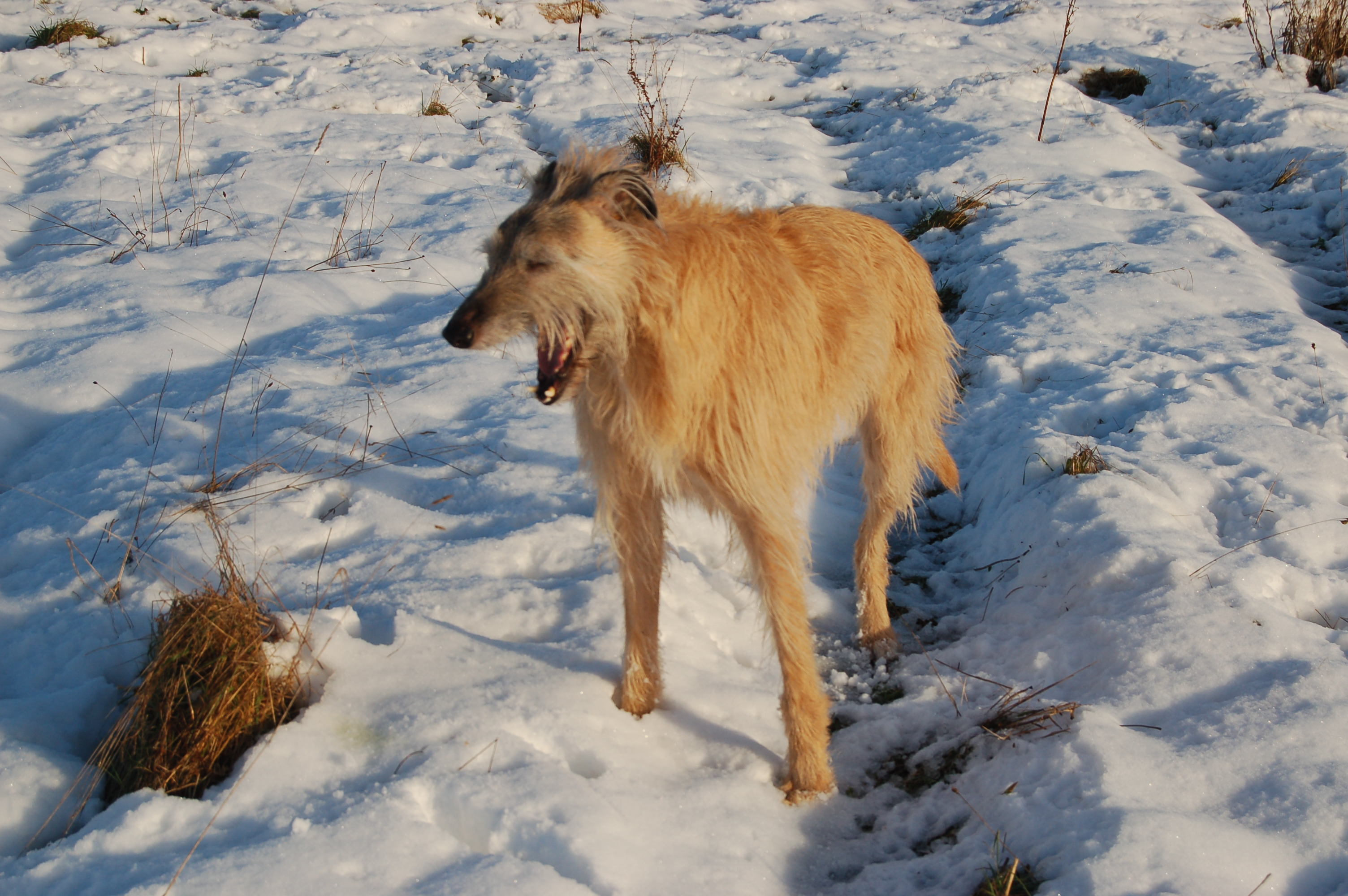
It is now 51 days since Frodo has his back right leg amputated due to bone cancer. He is thriving.

DSC_0084

This is him this morning – yawning in the snow after a hard night before. Hard being a vicar’s dog.

Thriving? After all, here is a dog who is a greyhound/deerhound lurcher who is used to chasing around with his brother, running through fields, streams and woods. Admittedly, that was easier to do when I was in Cumbria. Frodo, unlike my rotund self, is an athlete.

He is thriving in that he is eating, sleeping, walking, running (yes in the snow this has been the case), chasing feline creatures and enjoying the attention of Bartley Green.

Frodo seems to be content to do all that he can do, without (it seems) lamenting what he cannot do. As always, dogs seem to have the knack of putting their paw on something.

I have wasted a lot of life admiring others and wanting to be like them. I have sometimes strained too much to do what I cannot do, and therefore lost sight of my own abilities and end up not doing those things that I am good at.

If only I understood that to thrive does not mean to be perfect.

Posted in Uncategorized | 1 Comment